 Add to Chrome
 Add to Firefox
 Add to Edge
Evaluating the Feasibility of Inferring Dietary Behavior Change Receptivity from Egocentric Images of Eating Environment
May 27, 2026
Accurately assessing dietary behavior change receptivity is essential for designing effective just-in-time adaptive interventions (JITAIs) that promote healthier eating habits. However, self-report-based assessment of behavior change receptivity is sparse and delayed, limiting its practical use in continuous monitoring. To explore whether passive sensing may help address this challenge, this study conducts a pilot investigation of inferring participants' self-reported behavior change receptivity from egocentric eating images collected by a wearable camera. We use pilot data obtained from free-living eating episodes using the Automatic Ingestion Monitor v2 (AIM-2). The data included egocentric image sequences captured during eating and paired with responses to questions assessing specific dimensions of behavior change receptivity (awareness, interaction capability, and motivation). To examine whether visual information contained any relevancy to these responses, we evaluated a transfer-learning-assisted framework that combines a pre-trained Contrastive Language-Image Pre-Training (CLIP) vision encoder with a lightweight transformer classifier. The model processes eating episode image sequences to extract potential semantic and temporal cues related to behavior change receptivity. Preliminary experimental results show promising improvements over simple baseline models for behavior change receptivity indicators. These early findings suggest that egocentric eating episode images may contain cues related to dietary behavior change receptivity, and warrant further investigation with larger and more comprehensive datasets.

SPPO: Sequence-Level PPO for Long-Horizon Reasoning Tasks
Apr 10, 2026Proximal Policy Optimization (PPO) is central to aligning Large Language Models (LLMs) in reasoning tasks with verifiable rewards. However, standard token-level PPO struggles in this setting due to the instability of temporal credit assignment over long Chain-of-Thought (CoT) horizons and the prohibitive memory cost of the value model. While critic-free alternatives like GRPO mitigate these issues, they incur significant computational overhead by requiring multiple samples for baseline estimation, severely limiting training throughput. In this paper, we introduce Sequence-Level PPO (SPPO), a scalable algorithm that harmonizes the sample efficiency of PPO with the stability of outcome-based updates. SPPO reformulates the reasoning process as a Sequence-Level Contextual Bandit problem, employing a decoupled scalar value function to derive low-variance advantage signals without multi-sampling. Extensive experiments on mathematical benchmarks demonstrate that SPPO significantly surpasses standard PPO and matches the performance of computation-heavy group-based methods, offering a resource-efficient framework for aligning reasoning LLMs.
Leum-VL Technical Report
Mar 20, 2026A short video succeeds not simply because of what it shows, but because of how it schedules attention -- yet current multimodal models lack the structural grammar to parse or produce this organization. Existing models can describe scenes, answer event-centric questions, and read on-screen text, but they are far less reliable at identifying timeline-grounded units such as hooks, cut rationales, shot-induced tension, and platform-facing packaging cues. We propose SV6D (Structured Video in Six Dimensions), inspired by professional storyboard practice in film and television production, a representation framework that decomposes internet-native video into six complementary structural dimensions -- subject, aesthetics, camera language, editing, narrative, and dissemination -- with each label tied to physically observable evidence on the timeline. We formalize a unified optimization objective over SV6D that combines Hungarian-matched temporal alignment, dimension-wise semantic label distance, and quality regularization. Building on this framework, we present Leum-VL-8B, an 8B video-language model that realizes the SV6D objective through an expert-driven post-training pipeline, further refined through verifiable reinforcement learning on perception-oriented tasks. Leum-VL-8B achieves 70.8 on VideoMME (w/o subtitles), 70.0 on MVBench, and 61.6 on MotionBench, while remaining competitive on general multimodal evaluations such as MMBench-EN. We also construct FeedBench, a benchmark for structure-sensitive short-video understanding. Our results indicate that the missing layer in video AI is not pixel generation but structural representation: grounded on the timeline, linked to visible evidence, and directly consumable by downstream workflows such as editing, retrieval, recommendation, and generation control, including text-heavy internet video formats with overlays and image-text layouts.
DyJR: Preserving Diversity in Reinforcement Learning with Verifiable Rewards via Dynamic Jensen-Shannon Replay
Mar 17, 2026While Reinforcement Learning (RL) enhances Large Language Model reasoning, on-policy algorithms like GRPO are sample-inefficient as they discard past rollouts. Existing experience replay methods address this by reusing accurate samples for direct policy updates, but this often incurs high computational costs and causes mode collapse via overfitting. We argue that historical data should prioritize sustaining diversity rather than simply reinforcing accuracy. To this end, we propose Dynamic Jensen-Shannon Replay (DyJR), a simple yet effective regularization framework using a dynamic reference distribution from recent trajectories. DyJR introduces two innovations: (1) A Time-Sensitive Dynamic Buffer that uses FIFO and adaptive sizing to retain only temporally proximal samples, synchronizing with model evolution; and (2) Jensen-Shannon Divergence Regularization, which replaces direct gradient updates with a distributional constraint to prevent diversity collapse. Experiments on mathematical reasoning and Text-to-SQL benchmarks demonstrate that DyJR significantly outperforms GRPO as well as baselines such as RLEP and Ex-GRPO, while maintaining training efficiency comparable to the original GRPO. Furthermore, from the perspective of Rank-$k$ token probability evolution, we show that DyJR enhances diversity and mitigates over-reliance on Rank-1 tokens, elucidating how specific sub-modules of DyJR influence the training dynamics.
SQL-ASTRA: Alleviating Sparse Feedback in Agentic SQL via Column-Set Matching and Trajectory Aggregation
Mar 17, 2026Agentic Reinforcement Learning (RL) shows promise for complex tasks, but Text-to-SQL remains mostly restricted to single-turn paradigms. A primary bottleneck is the credit assignment problem. In traditional paradigms, rewards are determined solely by the final-turn feedback, which ignores the intermediate process and leads to ambiguous credit evaluation. To address this, we propose Agentic SQL, a framework featuring a universal two-tiered reward mechanism designed to provide effective trajectory-level evaluation and dense step-level signals. First, we introduce Aggregated Trajectory Reward (ATR) to resolve multi-turn credit assignment. Using an asymmetric transition matrix, ATR aggregates process-oriented scores to incentivize continuous improvement. Leveraging Lyapunov stability theory, we prove ATR acts as an energy dissipation operator, guaranteeing a cycle-free policy and monotonic convergence. Second, Column-Set Matching Reward (CSMR) provides immediate step-level rewards to mitigate sparsity. By executing queries at each turn, CSMR converts binary (0/1) feedback into dense [0, 1] signals based on partial correctness. Evaluations on BIRD show a 5% gain over binary-reward GRPO. Notably, our approach outperforms SOTA Arctic-Text2SQL-R1-7B on BIRD and Spider 2.0 using identical models, propelling Text-to-SQL toward a robust multi-turn agent paradigm.
Anchored Policy Optimization: Mitigating Exploration Collapse Via Support-Constrained Rectification
Feb 05, 2026Reinforcement Learning with Verifiable Rewards (RLVR) is increasingly viewed as a tree pruning mechanism. However, we identify a systemic pathology termed Recursive Space Contraction (RSC), an irreversible collapse driven by the combined dynamics of positive sharpening and negative squeezing, where the sampling probability of valid alternatives vanishes. While Kullback-Leibler (KL) regularization aims to mitigate this, it imposes a rigid Shape Matching constraint that forces the policy to mimic the reference model's full density, creating a gradient conflict with the sharpening required for correctness. We propose Anchored Policy Optimization (APO), shifting the paradigm from global Shape Matching to Support Coverage. By defining a Safe Manifold based on the reference model's high-confidence support, APO permits aggressive sharpening for efficiency while selectively invoking a restorative force during error correction to prevent collapse. We theoretically derive that APO serves as a gradient-aligned mechanism to maximize support coverage, enabling an Elastic Recovery that re-inflates valid branches. Empirical evaluations on mathematical benchmarks demonstrate that APO breaks the accuracy-diversity trade-off, significantly improving Pass@1 while restoring the Pass@K diversity typically lost by standard policy gradient methods.
IIB-LPO: Latent Policy Optimization via Iterative Information Bottleneck
Jan 09, 2026Recent advances in Reinforcement Learning with Verifiable Rewards (RLVR) for Large Language Model (LLM) reasoning have been hindered by a persistent challenge: exploration collapse. The semantic homogeneity of random rollouts often traps models in narrow, over-optimized behaviors. While existing methods leverage policy entropy to encourage exploration, they face inherent limitations. Global entropy regularization is susceptible to reward hacking, which can induce meaningless verbosity, whereas local token-selective updates struggle with the strong inductive bias of pre-trained models. To address this, we propose Latent Policy Optimization via Iterative Information Bottleneck (IIB-LPO), a novel approach that shifts exploration from statistical perturbation of token distributions to topological branching of reasoning trajectories. IIB-LPO triggers latent branching at high-entropy states to diversify reasoning paths and employs the Information Bottleneck principle both as a trajectory filter and a self-reward mechanism, ensuring concise and informative exploration. Empirical results across four mathematical reasoning benchmarks demonstrate that IIB-LPO achieves state-of-the-art performance, surpassing prior methods by margins of up to 5.3% in accuracy and 7.4% in diversity metrics.
Perception Before Reasoning: Two-Stage Reinforcement Learning for Visual Reasoning in Vision-Language Models
Sep 16, 2025Reinforcement learning (RL) has proven highly effective in eliciting the reasoning capabilities of large language models (LLMs). Inspired by this success, recent studies have explored applying similar techniques to vision-language models (VLMs), aiming to enhance their reasoning performance. However, directly transplanting RL methods from LLMs to VLMs is suboptimal, as the tasks faced by VLMs are inherently more complex. Specifically, VLMs must first accurately perceive and understand visual inputs before reasoning can be effectively performed. To address this challenge, we propose a two-stage reinforcement learning framework designed to jointly enhance both the perceptual and reasoning capabilities of VLMs. To mitigate the vanishing advantage issue commonly observed in RL training, we first perform dataset-level sampling to selectively strengthen specific capabilities using distinct data sources. During training, the first stage focuses on improving the model's visual perception through coarse- and fine-grained visual understanding, while the second stage targets the enhancement of reasoning abilities. After the proposed two-stage reinforcement learning process, we obtain PeBR-R1, a vision-language model with significantly enhanced perceptual and reasoning capabilities. Experimental results on seven benchmark datasets demonstrate the effectiveness of our approach and validate the superior performance of PeBR-R1 across diverse visual reasoning tasks.
The Choice of Divergence: A Neglected Key to Mitigating Diversity Collapse in Reinforcement Learning with Verifiable Reward
Sep 09, 2025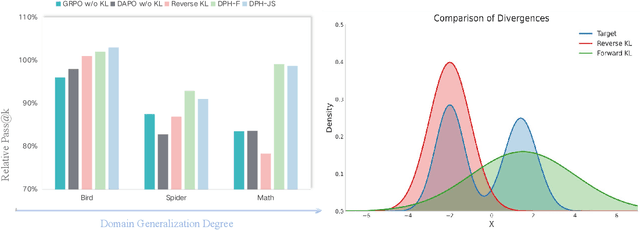
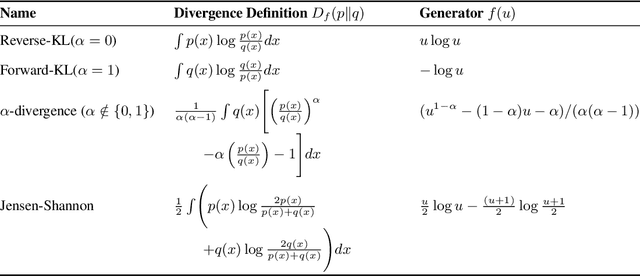
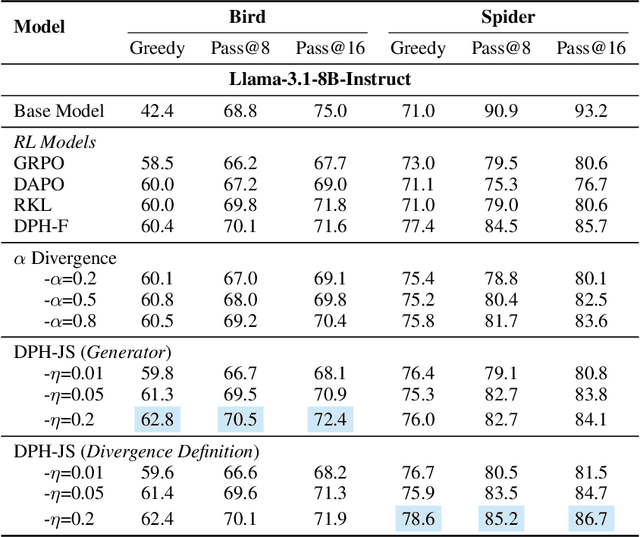
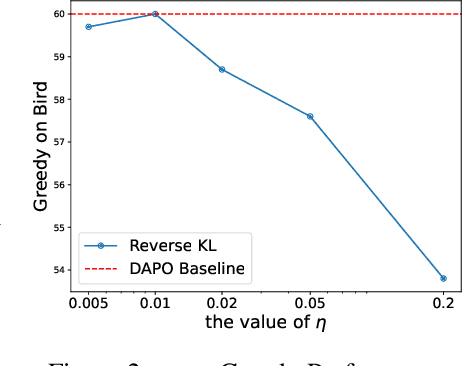
A central paradox in fine-tuning Large Language Models (LLMs) with Reinforcement Learning with Verifiable Reward (RLVR) is the frequent degradation of multi-attempt performance (Pass@k) despite improvements in single-attempt accuracy (Pass@1). This is often accompanied by catastrophic forgetting, where models lose previously acquired skills. While various methods have been proposed, the choice and function of the divergence term have been surprisingly unexamined as a proactive solution. We argue that standard RLVR objectives -- both those using the mode-seeking reverse KL-divergence and those forgoing a divergence term entirely -- lack a crucial mechanism for knowledge retention. The reverse-KL actively accelerates this decay by narrowing the policy, while its absence provides no safeguard against the model drifting from its diverse knowledge base. We propose a fundamental shift in perspective: using the divergence term itself as the solution. Our framework, Diversity-Preserving Hybrid RL (DPH-RL), leverages mass-covering f-divergences (like forward-KL and JS-divergence) to function as a rehearsal mechanism. By continuously referencing the initial policy, this approach forces the model to maintain broad solution coverage. Extensive experiments on math and SQL generation demonstrate that DPH-RL not only resolves the Pass@k degradation but improves both Pass@1 and Pass@k in- and out-of-domain. Additionally, DPH-RL is more training-efficient because it computes f-divergence using generator functions, requiring only sampling from the initial policy and no online reference model. Our work highlights a crucial, overlooked axis for improving RLVR, demonstrating that the proper selection of a divergence measure is a powerful tool for building more general and diverse reasoning models.
VL-Cogito: Progressive Curriculum Reinforcement Learning for Advanced Multimodal Reasoning
Jul 30, 2025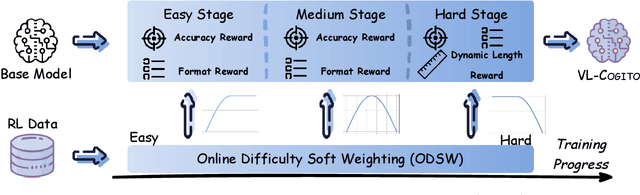
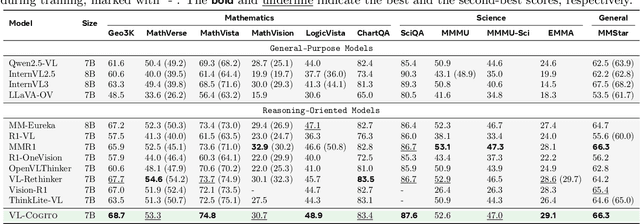
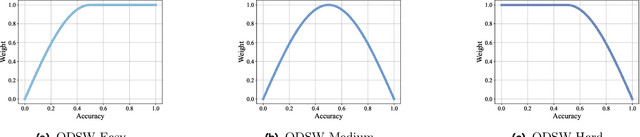

Reinforcement learning has proven its effectiveness in enhancing the reasoning capabilities of large language models. Recent research efforts have progressively extended this paradigm to multimodal reasoning tasks. Due to the inherent complexity and diversity of multimodal tasks, especially in semantic content and problem formulations, existing models often exhibit unstable performance across various domains and difficulty levels. To address these limitations, we propose VL-Cogito, an advanced multimodal reasoning model trained via a novel multi-stage Progressive Curriculum Reinforcement Learning (PCuRL) framework. PCuRL systematically guides the model through tasks of gradually increasing difficulty, substantially improving its reasoning abilities across diverse multimodal contexts. The framework introduces two key innovations: (1) an online difficulty soft weighting mechanism, dynamically adjusting training difficulty across successive RL training stages; and (2) a dynamic length reward mechanism, which encourages the model to adaptively regulate its reasoning path length according to task complexity, thus balancing reasoning efficiency with correctness. Experimental evaluations demonstrate that VL-Cogito consistently matches or surpasses existing reasoning-oriented models across mainstream multimodal benchmarks spanning mathematics, science, logic, and general understanding, validating the effectiveness of our approach.